Pages

Showing posts with label 2nd grade. Show all posts

Friday, September 18, 2015

Swat that bus!

If you've ever looked around this blog, you'll know that I love fly swatter games.  They are great for individual assessments - and the kids don't even know you're testing them!  You just split them into teams, and 2 at a time come and try to identify the rhythm that you clap.

Here are all the makings of a great lesson:

We first read the book "Don't Let the Pigeon Drive the Bus!" by Mo Willems.  You can see that book here:  


After every page, we practiced saying the phrase "Don't Let the Pigeon Drive the Bus."  The kids love the pigeon books, and so do I :)

Anyway, after the book was read, we figured out the rhythm together.  We decided it was "ta ti-ti ti-ti ti-ti ta rest rest rest."  We've been learning about bar lines, and it was a great moment to decide where the bar line was, and how many rests we needed to fill up that measure!

I found these foam buses in the dollar bins at Target.  I love foam manipulatives!  I have drawers and drawers full of them.

For only $1, it came with 10 pieces.  I was able to write different rhythms on them with a sharpie, and the fly swatter game commenced.

Great day!  We were able to incorporate literature, aural dictation, and aural assessments all on one day.

Tuesday, March 24, 2015

Play Parties and Pie!

I have always loved the song "Great Big House."
The melody is so catchy that even though I usually use this in 2nd grade for "re" and half note, I have used this very successfully in older grades for improvisation, I-V harmonies, etc.  The kids love it.

Of course, I prepared a file for Teachers Pay Teachers (found here) that has all of my regular stuff - intro to the rhythm, melodic preparation, etc.  It's all great stuff, if I do say so myself.

But, that's not why I'm here.  I'm here because I recently attended a conference, and up until then, I had no idea this song had a "game."  It's really an old play party song - so it's traditional and everything!  And, my goal for this year was to make the kids do more folk dances and move more, so this fits right in with my goal.  Yay!

Formation:  single circle, with class divided into partners

Verse 1:  The whole class stands in a circle and walks to the right (or the left, it doesn't really matter).

Verse 2:  Partner #1 walks to the center of the circle and joins hands with the other #1s.  Then, Partner # 2 reaches in between the center circle to join hands with the other #2s.  On "put one arm around my wife," the #2s raise their arms up and behind the #1s, and on "the other round my daughter," the #1s raise their arms up and behind the #2s.

Verse 3:  All shuffle to the right or left while still holding their hands in a "basket weave." 

The kids love this!  It is so much fun!  I am so surprised I didn't learn it until recently, but I'm so glad I did.

Here's a video of some random 3rd grade class I found on YouTube for better visualization:


Thursday, February 12, 2015

Pizza!

Who doesn't love a good pizza?  Many of you probably know this song:
My kids absolutely love this song!  I have used it successfully with my younger and my older students.  The melodic structure is very easy - uses just the pitches so, mi and la, but in a way that if you use this with older kids they won't think it's too "baby-ish."

I also find that my older kids just get really nervous singing in front of others.  However, if you give them a really fun call-and-response song like this, they don't really notice that they're singing a solo, and it gives you a chance to individually assess them in a non-threatening environment.

Last year, I was looking around on Pinterest, and I found a blog post about this song with some fantastic improvisation ideas:  Pizza, Pizza, Daddy-o improvisation.  The authors of this blog, Janet and Laura, came up with a great improvisation worksheet that I have used countless times.  My kids love it too - plus it incorporates a little bit of that "writing" technique that many of us now have to use with the Common Core stuff....  (printable version of this worksheet on their blog)


After the kids come up with their different movements, each student leads the class in what they came up with.  Side note - as a proud music teacher, I love that the group above used "compose it."  Made my day :)

Anyway, another extension idea I found was on Teachers Pay Teachers.  A new seller, Megan Bracciano, came up with these adorable pizza composition worksheets.  You cut out red circles for the "pepperoni" (my school has a die cut machine that is perfect for these) and the kids can glue them on.  It helps them practice writing music left to right, placing notes on lines or in spaces, etc.  She has 3 versions of these worksheets you can download for FREE!

One is with "high/low" - you can use this with your kiddos who haven't labeled "so-mi" yet:
Another version is with just "sol/mi":
And finally, this is the version I will be using with my 2nd graders, as we have just labeled "do":

After they glue on the pepperoni (or just color them on if you want to go that route), you can have them color the rest of the pizza with other toppings, or whatever you want to do.

So cute, right?!?!?!

Going back to the "Pizza, Pizza, Daddy-o!" song, I made some files for Teachers Pay Teachers (you can find it here) for my kids to practice the melodic patterns found in the song, both on and off the staff.

Off the staff:
On the staff, where do is in a space:
On the staff, where do is on a line:
I also made some printable tone ladders, both in color and black and white:

And I even added a steady beat chart, though I don't use this song for rhythm as it contains some complicated syncopation:
Improvisation slide:
Game/dance instructions:
A couple of other great places to find extension ideas on this song:


I also found another really cute song called "Rico's Pizza Restaurant" on Beth's blog that would be great for practicing "re" and using some improvisation!


Have lots and lots of fun with this song!  My kids LOVE it!

Just for funsies for you music teachers - love this clip by Brian Regan!  :)

Friday, September 5, 2014

Frere Jacques


Who doesn't know and love "Frere Jacques"?  This is a folk song that most of your kids even know, but there is so much you can do with it.  This is a great song to present half note, fa, low sol, part-singing, and so much more!  I'm using it this year to present half note to my 2nd graders.  We prepped and prepped half note at the end of last year, and have been reviewing it for this year.  I'm just about ready to present it (my 2nd graders this year are just amazing - this is slightly earlier than I've done it with 2nd grade in the past).  Anyway, we've been singing this song in class and doing different activities with it.  I had them do this little game/dance that I sort of made up:

Standing in a double circle in pairs, each circle walks to their right for 8 beats, then back for 8 beats to face their partner (1st 8 beats is "Frere Jacques," 2nd is "Dormez vous?")
Play patty-cake on next 8 beats (Sonnez les matines) clap-right-clap-left, clap-right-clap-left
On last 8 beats, wave good-bye and take one step to the right (opposite directions for circles) and face a new partner.  Repeat.

If you do this enough times, the kids should be standing in front of their original partners after a few turns.  My kids loved this!  I also loved that by counting the beats, they were internalizing that they took two steps on "vous" - a great prep for half note.

Another activity they really enjoyed is identifying the long notes.  We haven't labeled them yet, but they know where they are.  I had some students come up and play a few instruments that make "bell" sounds - finger cymbals, triangles, etc on the long notes.  Then, a student suggested that instead of singing, the instruments play the "din dan don" part on their own.  So great!  So, that inspired me to write a simple little Orff arrangement.  Feel free to adapt it to your instruments, change parts up, etc.  I've included a simple recorder part if you'd like to use it with recorders.

I created a file for Teachers Pay Teachers that can help when you present the half note, fa, or low sol, as this song is great for all of them!

It has a lot included, like iconic rhythmic notation:
Iconic melodic notation:
Actual rhythmic notation:
Song lyrics in English and French, and more.  You can find it here for $1.50 if you want to help contribute to my adoption fund :)  Frere Jacques


Since my focus this year is on music around the world, I'm choosing to teach this song in French.  I was looking around the internet the other day, and found this great website that has video clips of kids from different European countries singing this song in their own language:  Frere Jacques around the world.  So cute!  The kids get a kick out of this familiar song in so many languages!


Tuesday, September 2, 2014

Kokoleoko

As my theme this year is "Music Around the World," I've been looking into lots of different folk songs from around the world.  I found this little gem, Kokoleoko.  I've found it in several different places, all slightly different versions.  The version below is the most common, found in "Spotlight on Music, Grade 5," as well as several South American sources.

If you change one note of this song (the f sharp to an a), it is a great recorder piece - using only the notes G-A-B-C, as shown in this example:

The translation is pretty simple.  Apparently "Kokoleoko" is just another way of saying "cock-a-doodle-doo," and "ahby" is "goodbye."

Now, each source I find this song says something different about where exactly it's from.  Most often, they say either Liberia or Ghana.  So, I've just labeled it as a West African folk song to be more accurate.

Anyway, this song is great for teaching the half note, which I do in 2nd grade.  We spend awhile preparing, using songs that have half notes, before actually labeling what they are.  This song is also great if you bring it back in the end of 3rd/beginning of 4th, or whenever you teach syncopation.

There is a clapping game that goes with this.  It looks more complicated than it actually is.  My 2nd graders are challenged by this, but really enjoy doing it.  You can watch an example below:


I recently made a Teachers Pay Teachers product for this song that has rhythmic practice slides, melodic practice slides, clapping game instructions, and notation for both voice in the original version and recorder in the revised version.


There is even a great treble choral arrangement out there by Mary Donnelly and George Strid.  Here's a cute recording I found of it on YouTube:

Hope you can find use for this great song!  My kids are absolutely loving it :)

Sunday, April 27, 2014

More fly swatters!

A few weeks ago I was at Dollar Tree (I really should by stock in that store since I get a lot of stuff there) and found these awesome fly swatters:

Just for an idea on how big these really are, here is my 4-year-old daughter holding one up:

My students absolutely love them!  One student told me that these were big enough to "whack an elephant!" 
Love it!  You must go buy them now!

I have blogged before about my "fly swatter" games that I like to play in class.  I have recently uploaded a few products to Teachers Pay Teachers (some free) that would be great to use these with:

1. Rhythm flash cards (one set is free, the others are a bundled set).  I like these because they are color-coded by rhythmic concept. I include large flash cards for large-group practice, and smaller flash cards that you can print, cut out, and laminate for small group practice, fly swatter games, memory games, etc.

You can get the ta ti-ti set for FREE here:  Ta ti-ti flash cards

You can get the bundled rhythm set here:  Bundled flash card set  Not free, sorry - but $4 gets you lots and lots of flash cards for all of the following rhythmic concepts:  
ta, ti-ti, ta rest
half note, half rest
sixteenth notes (tika-tika or tiri-tiri)
sixteenth/eighth note combinations (ti-tika, tika-ti or ti-tiri, tiri-ti)
syncopa
dotted quarter, eighth note (tom ti)

Here is an example of what a flash card looks like:  Simple, but effective


2. Rhythm Fly Swatter game:  you can get the ta, ti-ti, ta rest set for FREE here:  Ta ti-ti rest bug swatter game

Here is an example of one of the printable pages.  You cut them out, laminate, and swat away!


3.  I don't just advertise my own stuff.  I would be nowhere without the examples and help from other music teachers.  One of my heroes - never even met her - is music teacher Amy Abbott.  Read her amazing blog here:  Amy Abbott's music blog.  Anyway, she has recently uploaded a lot of "fly swatting" games to TpT - with rhythmic, melodic, and recorder skills.  She has them for sale individually, in bundles, and more.  Check them out here:  Amy Abbott's fly swatter games.


Tuesday, March 11, 2014

More Buttons!

I am a HUGE fan of manipulatives.  Maybe it's because I'm a kinesthetic learner myself, but I feel that students learn better when they not only see and hear something, but when they experience it, or create it themselves.

Therefore, because of that belief, my husband can NEVER let me loose in "The Spot" at Target, or in any dollar store.  I am always finding things I can use for school.  Today's manipulative find is very easy - buttons!  You can find them basically anywhere - I found these at Walmart:


I'm using them for the song "Button You Must Wander."  I recently posted a PowerPoint presentation I have made that I'm offering for FREE on my Teachers Pay Teachers store.


This activity kind of enhances that presentation.
The main goal of this song is for students to hear, feel, and write quarter notes, eighth notes, and quarter rests.  So, I came up with these beat charts (also for free on TpT):


The students worked together in small groups - each with a beat chart (I did mine without the words because my students can totally handle it) and a pile of buttons.  For each beat with a quarter note (ta), they put one button.  For each beat with 2 eighth notes (ti-ti), they put two smaller buttons.  For the beat with a rest, they left it blank.  They worked together so well while doing this, and it was very nice to hear them clapping the rhythm of the song and pointing to the beat to figure it out:


And here's the finished product (sorry about the glare):


The kids truly enjoyed this activity - and it really helps that they felt so successful at it.


Do any of you use a favorite manipulative?

Saturday, March 8, 2014

Bluebird

My first paid product is up on Teachers Pay Teachers!


This product is to teach the song "Bluebird Through My Window," a song I use to present half note in second grade.  I call half notes "two" because it reminds kids of how many beats it gets, and in my classroom, my kids have gotten confused with "ta" and "ta-a."

The steps to my presenting something are pretty basic - first, after they have sung many, many songs with half notes (just not having specifically identified them yet), I teach this new song, by rote.  We first find the steady beat, then the rhythm.  They are able to clap the rhythm before we identify it.  Finally, when they have identified that there is a place where we are holding the note out for two counts, we define it as the half note.

I generally don't use this song for melodic practice, because it has both "fa" and high "do," both which I don't get to in grades K-2 - BUT, I've included slides for them in case you can find something useful :)

You can find it here:  Bluebird Through My Window

The game with this song is pretty fun for K-2.

Game #1:  All students are in a standing circle with arms raised, with palms of hands pressing on their neighbors’ hands to form “windows.”  One person who is “it,” or the “bluebird,” flies in and out of the windows as the song is sung, and taps boys or girls on the shoulder.  These boys or girls hold hands with the leader, forming a line, as the line grows longer and longer, flying in and out of the windows.  When the last two children remain in the circle, they become the bridge, as in “London Bridge” or “Apple Tree” and the bluebird leads the line through the bridge.  Whoever gets caught in the bridge on “tired” will be the bluebird the NEXT time we play the game.

I found this adorable video of kids playing the game:  Bluebird game

Sunday, October 27, 2013

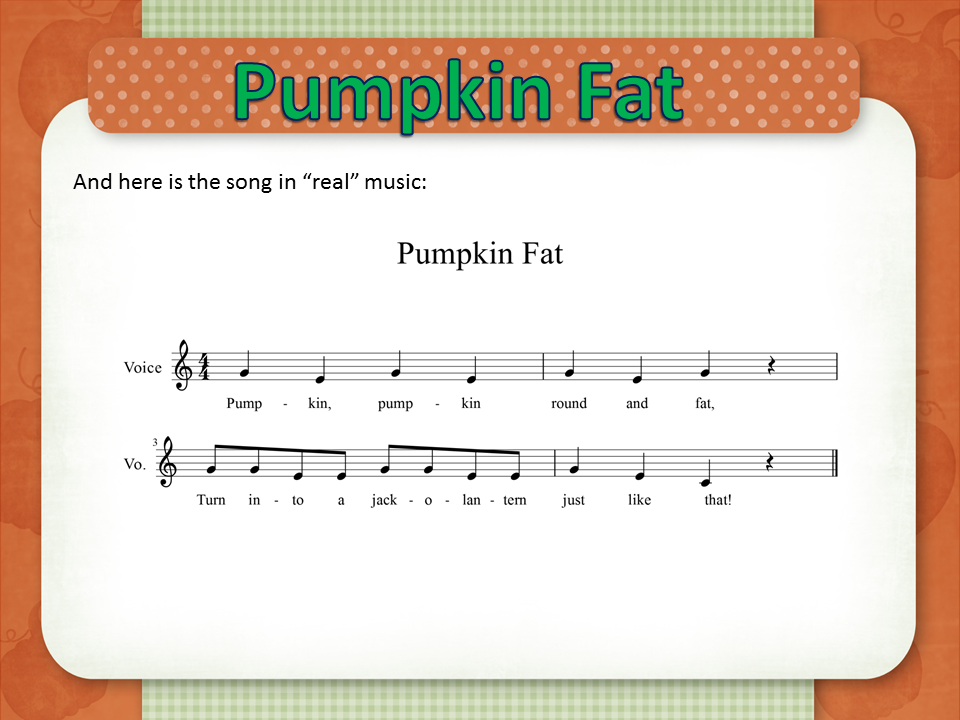
Pumpkin Fat

This is a great song to use with your kiddos at Halloween that's not necessarily Halloween-y.  It does mention the word "jack-o-lantern," but that's as bad as it gets :)

When this song was introduced to me, it ended with a "so-mi-so" pattern, but everybody just kept singing "so-mi-do" - not on purpose, and I think that works better.  I made this PowerPoint for my kids, and I can use it for both introducing rests and for introducing "do."  In 1st and 2nd grade, I begin working with a 3-line staff, and don't really start adding more lines until mid-2nd grade or so.


I recently went to a district training where we talked about how to incorporate Common Core into the music classroom (this is where this song was introduced to me).  We can talk about personal feelings about Common Core another time, but since my district is implementing it, I'm trying to do this the best I can.  It was suggested for this song to incorporate it with K-3 Common Core Math Standards, defined as:

"Asking students the right questions is an essential part of the learning process.  Questions are the easiest way to incorporate the Common Core State Standards in the area of K-3 Mathematics while teaching music.  Students are more engaged in every moment of the lesson when using questions in the process."

The presenter suggested that we use craft sticks and pipe cleaners to create the rhythms and bar lines.  Students create the rhythms and bar lines (counting, division, etc).  Take turns:  some students pat the beat while the others chant/tap rhythm patterns.  Then, replace patting and tapping with instruments.  Rotate instruments, and count off the rotation.

The training made it easier for me to accept Common Core, because it's not that much different from what we already do as music teachers - all we need to do is ensure we are asking better thought-provoking questions, and most importantly, to have the students be the problem-solvers.